

Choosing the Right Decanter Centrifuge: Fixed-Speed vs. VFD

Optimizing drilling economics requires selecting a high-performance decanter centrifuge to remove fine colloidal solids and maintain proper fluid properties. Choosing between fixed-speed and variable-frequency drive (VFD) configurations remains a critical engineering decision for field managers. To help field teams balance cost-effectiveness with process flexibility, we break down the core technical differences and selection logic for these two driving setups.

Technical Variations of the Decanter Centrifuge

Each drive configuration alters the fluid dynamics and processing capabilities of the decanter centrifuge to match specific drilling mud properties:

1. Fixed-Speed Configuration

  • Operational Mechanism: This design utilizes fixed gear ratios to run the bowl and the internal conveyor screw at constant, preset speeds.
  • Low-Speed Operation: This setup concentrates primarily on real-time barite recovery during drilling, preventing the loss of expensive weighting agents.
  • High-Speed Operation: This mode runs continuously at its upper velocity limit to provide secondary and tertiary solids control, systematically separating fine colloidal contaminants larger than 2 microns.
  • Ideal Field Scenarios: This option performs best in standard onshore drilling campaigns with predictable geological formations and minimal mud density fluctuations. It represents a highly cost-effective, classic choice for remote jobsites with limited budgets that demand high mechanical availability and simplified operator controls.

2. VFD Configuration

  • Operational Mechanism: This model integrates an intelligent, centralized variable-frequency drive control system. It eliminates rigid mechanical speed limits, allowing crews to adjust bowl velocities seamlessly across a broad range from 0 to 3900 RPM.
  • Ideal Field Scenarios: This drive system is built for complex operations, including extended-reach wells, oil-based mud (OBM) loops, and zero-discharge waste management projects. When the incoming slurry solids concentration increases rapidly or exhibits non-Newtonian behavior, the VFD system utilizes automated torque tracking to adjust differential speed and centrifugal forces instantly, optimizing the retention time inside the bowl.

Heavy-Duty Engineering of the KOSUN Decanter Centrifuge

Regardless of your chosen drive configuration, KOSUN manufactures every heavy-duty decanter centrifuge to the same rigid engineering standards:

  • Wear-Resistant Metallurgy: The cone discharge ports feature quick-replaceable tungsten carbide inserts, and the conveyor screw faces are fully tiled with hard-faced tungsten carbide layers to resist severe fluid erosion.
  • Global Standard Supply Chain: The rotational core integrates premium bearings sourced strictly from SKF or FAG to maximize mechanical uptime.
  • Shear-Free Fluid Feeding: The system pairs flexibly with progressive cavity pumps or submersible slurry pumps, ensuring continuous feeding without causing shear degradation to the active drilling mud.

Conclusion

In summary, matching the correct decanter centrifuge drive to your field parameters secures stable solids control performance and protects your active mud investment.
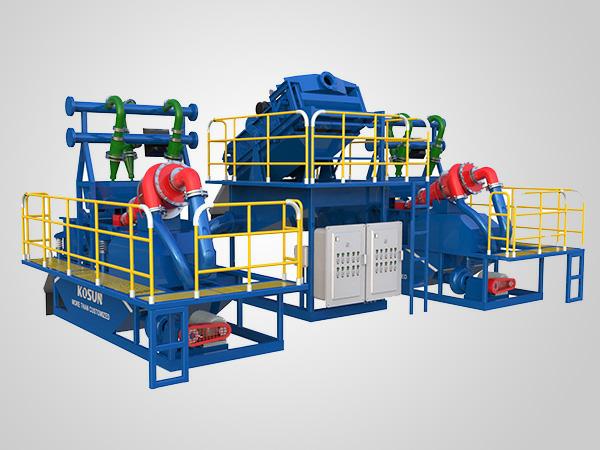
Introduction of the Main Equipment for Solid Control System

Recent years, with the requirement of high working efficiency in drilling industry, a new system has been designed and developed in some big solid control manufacturer, and the system is called “solid control system”. Kosun as the leading original manufacturer of solid control equipment and drilling waste management unit, the “solid control system” is not a problem for us.How to understand solid control system? As the professional solid control system manufacturer, we have our own understanding about this system.

Introduction of the Main Equipment for Solid Control System:

The first main equipment for solid control system should be the vacuum degasser,We could analytics from the function of vacuum degasser. Generally speaking, horizontal vacuum degasser will be used to separate the gas from the drilling solids. What’s the reason to do like that? Because we should do everything to prevent any dangerous elements in oil & gas drilling fields. That’s why we should put the vacuum degasser as the first role.

The second one should be mud cleaner. KOSUN MD Series Mud Cleaner is the second stage separation equipment for drilling fluids, which deals with the mud being treated by the first grade separation equipment. The barite will be recovered and cuttings which are bigger than barite will be removed. Then the barite in the underflow will flow into circulation tanks through the screens when the weighted mud passes while the particles that are bigger than mesh will be removed.

The third equipment, we think it should be shale shaker (with necessary steel frame shaker screen). Actually, after the drilling solids have been transported and fed into vacuum degasser and mud cleaner, the third step is going with shale shaker. Commonly, we still need to be transported the solids onto the shale shaker, or we could say onto the surface of shaker screen. The equipment of transporting we should use is centrifugal sand pump or screw pump; and we may use shear pump to cut the drilling solids into small one if they are in big size. With the different design of the shaker screen’s mesh, we could get the drilling solids separated in different sizes.

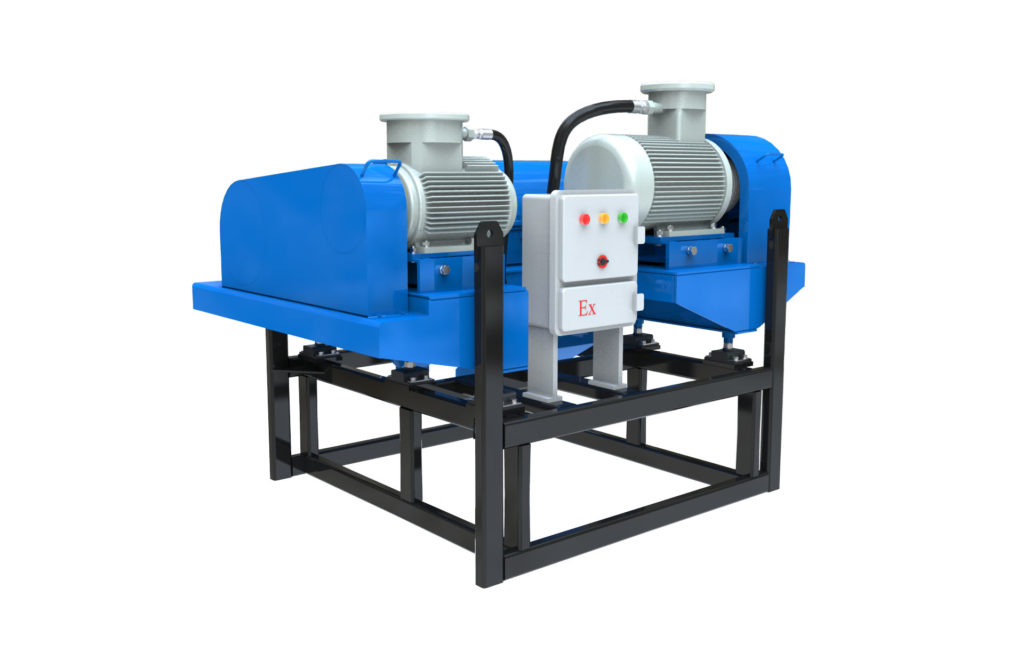
The fourth equipment should be the decanter centrifuge. KOSUN DC Series Decanter Centrifuge is used to separate suspended solids ≥2μm in diameter and treat the drilling mud and fluids. It is especially effective when used in oilfield service industry, industrial service industry and especially in environmentally sensitive areas. This type of centrifuge is high in recovery rate, effective in solids control and remarkable in the reduction of cost spent on drilling mud resupplying and management. It is a very sophisticated dynamic balancing machine, able to operate stably with the whirling speed ranging from 0 to 3900 and generate centrifugal force of 3000G. In solid control system, decanter centrifuge has been popularly used, which is also the popular one for drilling waste management. In this step, we could not only get the result of separating, but also we could separate the oil from the drilling solids, even if the oil is just a little part.

Of course, the whole equipment must be mounted on the top of drilling mud tank, which is a kind of basic equipment for both solid control system and drilling waste management (vertical cutting dryer is the core equipment for this system), but it is a kind of powerful equipment.

KOSUN was founded in Xi’an China in 1992. Up to now, KOSUN has formed a strategic layout integrating three centers and two industries. The Production, R&D and Domestic Sales Center is located in Xi’an China, the Overseas Project Management Center and International Trade Center in Beijing China and the Oilfield Services and Oilfield Engineering Center in Aktobe Kazakhstan in Central Asia. The two industries are traditional oil drilling solids control equipment manufacturing industry and integrated oil & gas drilling waste management service industry respectively.
Kosun- Solid Control System Company

Slurry TBM Treatment Stations of Kosun Manufacturer

Slurry TBM Treatment Stations

Slurry TBM treatment stations of Kosun manufacturer that focus on oil drilling, environmental protection 25 years and other areas of mud water treatment, mud separation solutions and equipment supply, Kosun Slurry treatment system are widely used at home and abroad.

1. Shield mud dehydration centrifuge, sewage dehydration correct. Dehydration centrifuge with high efficiency, energy saving, balance, high temperature, wear resistance and so on. Industrial centrifuges were born in Europe, such as the mid-19th century, there have been three-foot textile dehydration centrifuge, and the sugar factory separation of crystalline sugar with the hanging centrifuge. These early centrifuges are intermittent and artificial slag.

Kosun slurry tbm treatment stations
slurry tbm treatment stations

The centrifuge has a cylinder that rotates about its own axis at high speed, called a drum, usually driven by a motor. Suspension added to the drum, was quickly driven with the drum at the same speed rotation, under the action of centrifugal force components separated, and were discharged. Usually, the higher the drum speed, the better the separation effect.

2. Decanter centrifuge in environmental protection applications mainly refers to the industrial and civil wastewater treatment process of sludge dewatering. Today’s environmental problems become the focus of common concern around the world, in this context, the value of the decanter centrifuges is reflected in the previous sewage plants or related treatment plants are self-settling or the use of belt filter press sludge dewatering concentration, The test shows that the sludge moisture content is reduced from 98% to 80%, and the volume can be reduced by 10 times.

slurry tbm treatment stations

Because of this, the decanter centrifuge has the characteristics of large capacity, automatic operation and good dehydration effect in the environment The field of protection has been widely used and promoted. Decanter centrifuge single product sales accounted for about half of all centrifuge products, laid its irreplaceable position. In foreign countries, mud treatment equipment can choose] decanter centrifuge.

Slush, clear water, no follow-up costs, 24-hour operation of the equipment, stable operation, handsome in appearance, all closed without side leakage), the water supply,