

How to Choose KD-50 to KD-200 Purification Systems for Different Strata

Slurry treatment systems (KD series) are vital in trenchless and foundation engineering, as selecting the right unit directly impacts timelines and profits. When facing the KD-50, KD-100, and KD-200, how can contractors make a precise selection? The key lies in matching the strata material properties with the processing capacity requirements.

KD-50: The Flexible Choice for Small-scale Projects

If your project involves small slurry balance shields, rotary bored piling, or horizontal directional drilling (HDD) with low processing volume requirements, the KD-50 compact slurry separation system is the optimal choice.
Application Scenarios: Urban pipeline pipe-jacking, pile foundation construction in narrow areas.
Selection Logic: Relatively stable strata with extremely high requirements for equipment footprint. With its minimal physical dimensions and rapid deployment capability, the KD-50 minimizes transportation and installation costs.

KD-100: The Balanced Tool for Small and Medium-sized Projects

The KD-100 system is specifically designed for small and medium-sized pile foundations and shield projects, with a structure that emphasizes modularity.
Core Configuration: Equipped with a combination shale shaker and a 12″ diameter desander cyclone.
Selection Logic: When the sand content in the strata is high, the secondary purification advantage of the KD-100 becomes prominent. After coarse screening, the mud enters the desanding module where the pump set effectively removes sand, followed by fine screening for drying and discharge, balancing processing speed with purification precision.

KD-200: The Performance Benchmark for Large and Complex Strata

For large-scale diaphragm walls, trench cutters (double-wheel milling), or high-intensity shield tunneling, the KD-200 slurry treatment system provides stronger throughput and a more capable solution for challenging strata.
Application Scenarios: High water content, high clay content, or complex and variable strata environments.
Selection Logic: When the processing requirement is large (e.g., above 200m³/h) and the strata materials are complex, the KD-200 utilizes a wider screen surface and more powerful drive configuration to ensure no mud leakage or clogging under heavy-duty loads.

Selection Summary

Space Considerations: Choose KD-50 for extremely limited sites.
Sand Content: Choose KD-100 with the desanding module for thick sand layers.
Project Scale: Choose KD-200 directly for large diaphragm walls or high-capacity operations.

The KOSUN KD series supports full customization of electrical systems and D50 cut point designs. Regardless of the model selected, it ensures your project achieves maximum efficiency while remaining environmentally compliant.

How KQG30 Achieves Closed-Loop Recycling of Tank Cleaning Wastewater

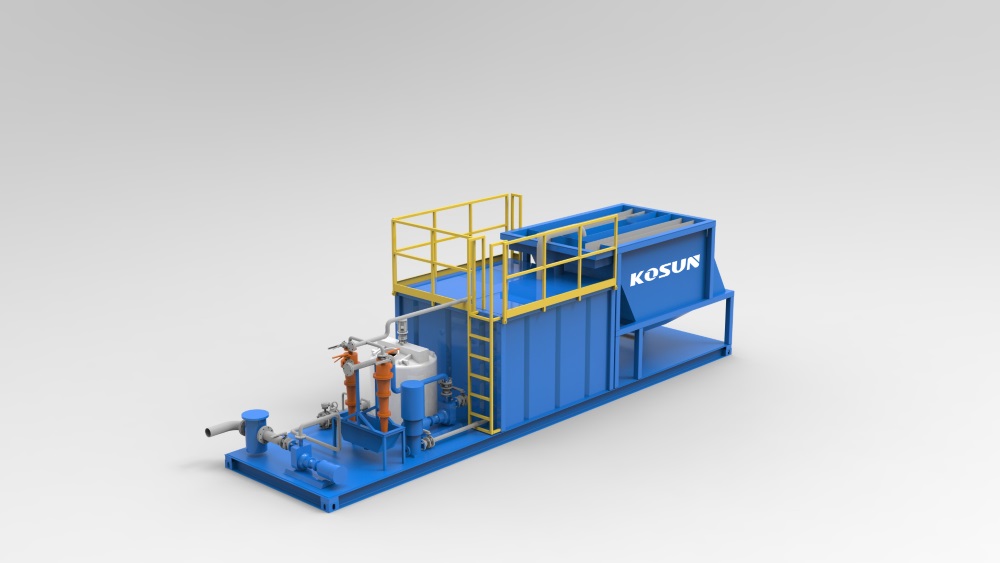
In the field of energy extraction and storage, cleaning sludge from the bottom of solids control systems and crude oil storage tanks has long been a high-energy and complex undertaking. Traditional cleaning methods not only consume vast amounts of fresh water but also generate large quantities of difficult-to-treat waste. The KQG30 Automatic Tank Cleaning System, developed by KOSUN, provides a rigorous and efficient closed-loop wastewater recycling solution through integrated physical separation processes.

Core Process Driving Multi-Stage Physical Separation

The operational logic of this unit lies in the synchronization of cleaning and purification. With a processing capacity of 30m³/h, the process chain consists of multi-stage linkage including filtration, inclined plate sedimentation, and hydrocyclone separation. At the start of operations, a high-pressure pump drives a mechanical cleaner installed at the top of the tank for spraying, while a self-priming pump extracts the flushed sludge into the treatment system. After initial filtration to intercept large impurities, the fluid enters the inclined plate sedimentation zone. Here, using the principle of increased sedimentation area combined with a dosing device, fine suspended solids flocculate and settle rapidly. Subsequently, a cyclone feed pump forces the fluid into the hydrocyclone unit, where a powerful centrifugal force field achieves complete solid-liquid separation.

Closed-Loop Design for Resource Recovery and Reuse

The ingenuity of this closed-loop design is that treated cleaning water can be returned directly to the clean water tank for reuse, greatly reducing dependence on external water sources. Integrated diaphragm pumps and high-pressure pump sets ensure stable fluid circulation within the system. Recovered waste oil can be reused after treatment, and the recycling of cleaning water reduces water consumption, fundamentally lowering production costs. This design not only significantly shortens the cleaning cycle but also transforms what was once waste into reusable resources.

Automated Configuration Ensuring Operational Safety

Beyond its process advantages, the KQG30 Drilling Mud Tank Cleaning Equipment demonstrates high industrial standards in hardware integration. The system includes an electrical control cabinet with an overall explosion-proof rating of Exd II BT4, making it fully capable of operating in high-risk environments such as crude oil storage tanks. The automated equipment can replace personnel in hazardous environments like confined spaces, significantly reducing operational risks. This easy-to-operate system supports rapid extraction and cleaning, and when paired with skid-mounted water tanks and dosing units, achieves efficient and compliant modern tank cleaning that aligns with the core concepts of green production and sustainable development in the global energy industry.

Field Application of KOSUN Arctic Drilling Mud Solids Control System in Russia

In the global energy map, arctic regions like Siberia hold vast reserves, yet temperatures plummeting to -40°C impose harsh demands on drilling equipment. Conventional solids control systems often suffer from frozen pipelines and brittle fractures in such cold. KOSUN’s Arctic Solids Control System is specifically engineered to break these environmental barriers.

Core Technology: Resilience and Flexibility
The system’s design centers on “extreme cold survivability.” All components use specialized low-temperature resistant materials to ensure stability at -40°C. Its skid-mounted, modular design allows for easy mobilization across ice fields and rapid assembly; once interface pipelines and power are connected, it is ready for action. Notably, the 1000GPM Orbit system supports simultaneous drilling for multiple wells, moving smoothly via hydraulic cylinders to maximize group-drilling efficiency.

Case Study: Russia-ZJ30 Rig Solids Control System
KOSUN’s expertise is perfectly demonstrated in the Russia-ZJ30 project. This system is a comprehensive processing hub integrating mechanical separation and electrical control. To counter the Russian frost, it features fully enclosed insulation sheds and steam heating pipelines. This setup not only improves working conditions but also ensures mud fluidity through a five-stage purification process (shale shaker, desander, desilter, vacuum degasser, and centrifuge).

Efficiency and Resource Recovery
From mixing and weighting to degassing and supplying, the ZJ30 system manages the entire lifecycle of drilling fluids. By precisely controlling mud properties, it significantly reduces the consumption of expensive chemicals, providing a robust technical guarantee for polar drilling operations.